
Animal Control
Why we need to come to terms with our ancestral instincts.

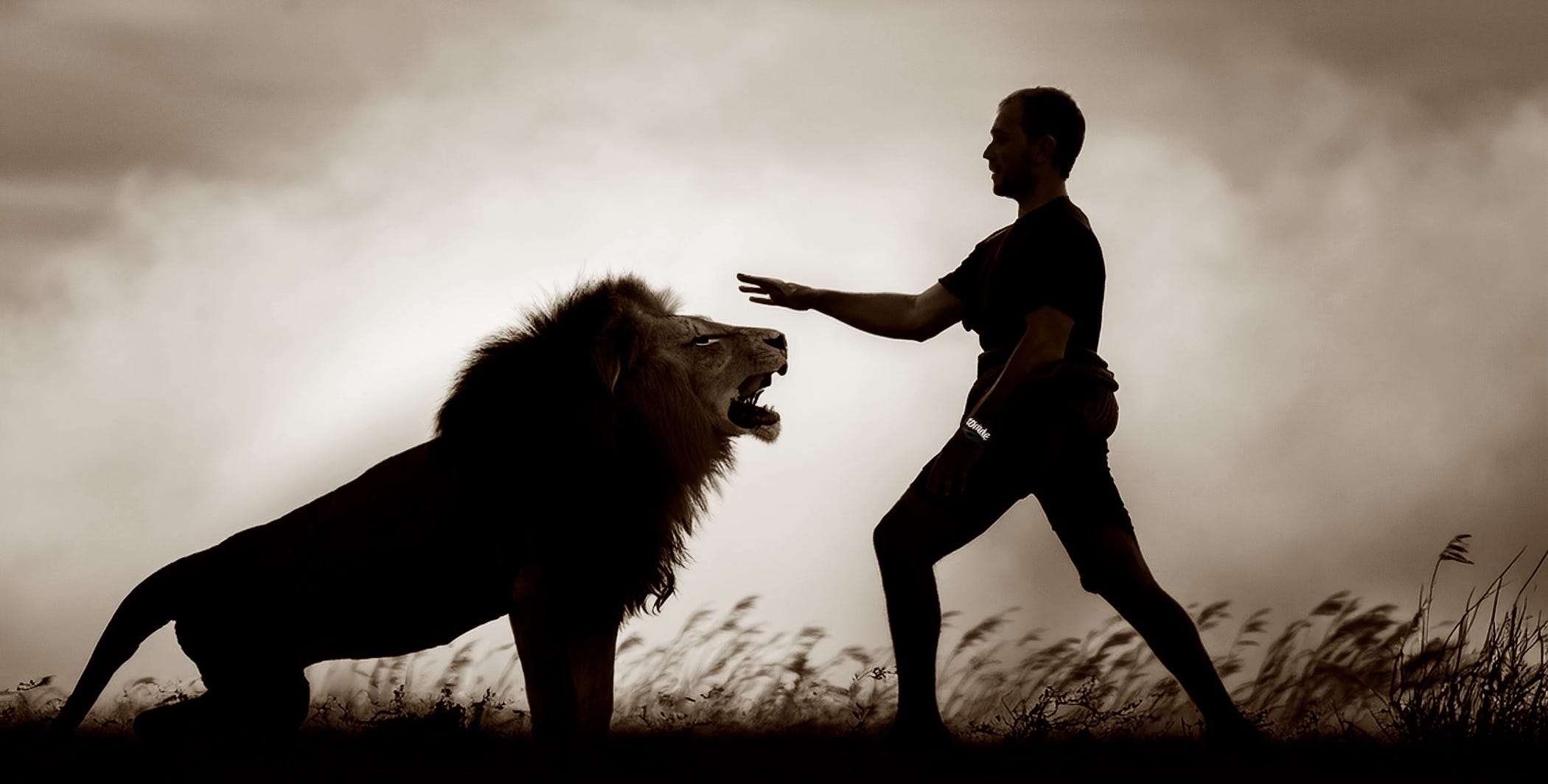
The Gospel of Thomas – one of the so-called “Gnostic Gospels” written within the same time frame as the Gospels of Matthew, Mark, Luke, and John – has a teaching from Jesus I’d never read before that seems particularly relevant to our times:
“Blessed is the lion which becomes man when consumed by man; and cursed is the man whom the lion consumes, and the lion becomes a man.”
A lion “consumed” by man is symbolic of bringing our animal instincts under our conscious control, where, together with our higher level cognitive abilities, they’re able to serve humankind’s best interests (and are thus a blessing). A man “consumed” by a lion is symbolic of our animal instincts operating beyond our conscious control, where they’re able to hijack our higher level cognitive capacities for purposes that are often self-serving, dangerous and destructive (and are thus a curse).
It’s an instructive teaching. We often justify some of our more problematic qualities as instinctual characteristics inherited from our ancestral past, believing little can be done to change them. Tribalism and fear of “the other” come to mind as examples, as does our instinct for self-preservation and retaliation – to do unto others what others have done to us.
Yet there’s an important difference between our own instincts and those of our non-human cousins. Their instincts are bookended by a Start and a Stop button. The instinct to eat is balanced by an instinct to stop eating once the need has been met. Nothing is done to excess. There’s no hoarding, no “laying up of treasure” beyond what is needed.
Absent human interference, nature has somehow managed to keep the instinctual behaviors of other species within a certain boundary, one that preserves a delicate balance within which life as a whole thrives. There’s unity within diversity and diversity within unity. Everything works to Life’s ultimate benefit. It’s all one.
Within the human species, however, things look different. Our instincts have a Start button, but the Stop button appears weak at best. If we want to eat far beyond the amount needed to replenish our energy, so be it. If we want to hoard more money than we need, so be it. If we want to mass murder other members of our species, so be it. If we want to push other species to extinction, so be it. If we want to build, sell and use weapons of global mass destruction, so be it.
Of course, there’s a price to pay for such “freedom.” In our societies and in nature at large, we’ve thrown the balance of life into a violent and volatile state of disequilibrium. Rather than having diversity within unity, we have diversity within chaos.
The good news is that suffering through times of extreme imbalance logically creates a desire to restore balance. The big question, though, is how to do so.
Some – perhaps many – believe the needed rebalancing will only come at the hands of a powerful leader or savior – a belief so desperately held its adherents are prone to see a savior where one does not exist. In reality Donald Trump is just the embodiment of the same unbounded and unconscious animal energy that created the chaos in the first place: An alpha male who will gladly separate the wheat from the chaff, but only as he defines them – definitions that just happen to serve his interests alone. Rather than restoring balance, he exacerbates the chaos for his own ends.
But if we remember that this president is the personification of our nation’s collective id (Freud’s term for our unchecked instinctual impulses), and not the cause of it (at least, not any more than you, me, and anyone else who has enjoyed the short-term gains of our long-term assault on the planet and those who live upon it) then the path forward is ours to chart. If we want a country – and eventually a world – no longer dominated by unrestrained base animal instincts, we need to consciously choose for ourselves the same boundaries nature gave all other species: to align these ancient energies with the principle that the wellbeing of the parts and the wellbeing of the whole are inseparable.
So if that were to be our goal, how might we get there? One step we can take is to show our support for the radical changes necessary.
Imagine a new political party is beginning to form, the objective of which is to put us back in balance with each other and the rest of life. You’ve been asked if you would support such a party with these proposed goals and priorities:
The creation of a new form of capitalism no longer based on perpetual material growth, but that instead prioritizes people and the balance of nature over profits.
A ban on the building and deployment of weapons of mass destruction – recognizing that our existing ability to destroy the earth 19 times over is enough.
A ban on all international weapons sales, recognizing the immorality of profiting from death and destruction.
A relationship-based approach to international relations and a commitment to the non-violent resolution of conflict.
A ban on the corruptive influence of money in politics.
A commitment to bring our consumption of resources to a level that the planet can sustain and that allows for the basic needs of the rest of humanity to be met.
Would you support such a party? Would you help give it birth? If not, what are the sticking points? What changes would address your concerns? What would you want to see added to the list?
I hope you’ll share your thoughts on those questions because this is an important exercise. The reason the leaders of the Democratic Party seems impotent in the face of Trump has nothing to do with Trump. It’s that they cannot think radically enough. They’re as wedded to the existing system as their republican counterparts – the same system that has thrown us all out of balance. If we want our leaders to set things right, if we want them to be willing to think outside the box, to venture into uncharted territory, then they need to know we’ll go there with them.
So, would you go there? Are we ready to consent to nature’s boundary and build that kind of society? That kind of relationship with the rest of life? Personally, I don’t see another choice if we want our species to survive. Do you?
thank you!!! profound as always.
Wonderful, thought provoking and timely - thank you, Kern! Yes, I'd support this.